

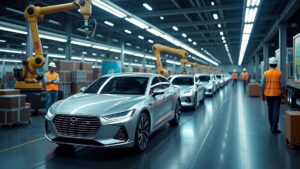







When you consider the future of the automotive industry, artificial intelligence (AI) is no longer a distant possibility but a defining reality reshaping every layer of the mobility stack—from chips powering your vehicle’s brain to the sophisticated software and platforms enabling new business models. For you, as an automobile industry leader, investor, or policymaker in India, understanding this AI-driven transformation isn’t optional; it is critical to securing your foothold in an increasingly competitive global marketplace.
Why This Matters to You
You are navigating a landscape where automotive innovation is pivoting from traditional hardware-centric approaches to software-defined, intelligent mobility solutions. AI integration accelerates the evolution of electric and hybrid vehicles, driving autonomy, predictive analytics, and energy management—all key to manufacturing leadership, supply chain resilience, and export competitiveness.
India’s aspirations as a manufacturing and export hub align closely with its ability to embed AI capabilities within its automotive ecosystem. Failing to grasp the strategic implications of AI in the mobility stack risks leaving your business behind as global OEMs and suppliers reinvent their roles and value chains.
What Is Happening in AI and the Automotive Mobility Stack?
The infusion of AI into chips, software, and platforms represents more than incremental improvement; it is a fundamental rebuilding of what vehicles are and how they create value.
- AI-Powered Semiconductors: AI accelerates chip design and performance tailored specifically for real-time vehicle functions, from sensor processing to energy efficiency.
- Software-Defined Vehicles: Vehicles are now platforms where software updates, enabled by AI algorithms, continuously improve safety, driver assistance, and connectivity features remotely.
- Interconnected Mobility Platforms: AI-driven platforms manage fleets, charging infrastructure, and user experience through predictive analytics and intelligent service orchestration.
Key Strategic and Market Implications
- OEM and Supplier Realignment: You must rethink your R&D, supply chain, and partnership strategies to prioritize AI-focused semiconductor and software development. Localising chip manufacturing and software capabilities is no longer optional but a strategic necessity.
- Acceleration of Software-Defined Vehicles: The competitive landscape will favour those who master AI integration to deliver seamless over-the-air updates and advanced driver-assistance ecosystems.
- New Business Models and Platform Ecosystems: You can leverage AI to build connected mobility services, fleet management solutions, and intelligent energy networks, enhancing revenue streams beyond vehicle sales.
- Investment and Innovation Priority: Investments aligned with AI innovation, especially in semiconductors and software startups, will determine your ability to lead India’s transition toward electric mobility and export scalability.
Deeper Strategic Insight for India’s Automotive Ecosystem
India stands at a strategic inflection point where the convergence of AI, electrification, and connectivity could establish it as a global mobility leader. But this requires an orchestrated effort across your semiconductor manufacturing, software development, OEM collaborations, and mobility service providers.
Embedding AI into India’s automotive value chain will unlock new pathways for cost competitiveness, operational excellence, and product differentiation. The shift to AI-enabled mobility is not just a tech upgrade—it is a transformative business strategy reshaping your entire value proposition.
“The real edge is not only in building vehicles, but in controlling the technology, supply chain, and customer experience behind them.”
Practical Takeaways: What You Should Do Next
- Understand AI as a Core Competency: Make AI integration a strategic priority in your R&D and product development initiatives, especially in software and semiconductors.
- Localise Critical Components: Focus on developing domestic AI chip manufacturing and software services to reduce dependency on global supply chains and improve resilience.
- Forge Ecosystem Partnerships: Collaborate with startups, tech companies, and government bodies to build AI-enabled mobility platforms that create new revenue opportunities.
- Invest in Talent and Innovation: Upskill your workforce and actively invest in AI startups to sustain innovation leadership and competitive advantage.
- Monitor Policy and Market Trends: Keep a watch on governmental incentives, EV adoption rates, and shifts in global trade policies to strategically align your investments.
Challenges and Considerations
As you push forward, be aware of regulatory complexities around data privacy, cybersecurity, and AI ethics. The high capital intensity in semiconductor localisation and software development demands rigorous strategic evaluation. Additionally, balancing legacy manufacturing with AI-driven innovation can strain resources and require thoughtful change management.
“In the automobile industry, speed is valuable — but strategic timing creates lasting advantage.”
What to Watch Next
Stay alert to key developments such as government policies promoting AI and semiconductor manufacturing, new global partnerships in software-defined vehicles, and breakthroughs in AI-driven battery management and charging infrastructure. Tracking emerging mobility platforms leveraging AI will give you early insights to adapt your business model effectively.
Conclusion
How AI is redefining the mobility stack is central to the future-proofing of India’s automotive industry. For you, embracing AI-driven innovation means securing competitive positioning not just through manufacturing scale, but through smart integration of chips, software, and interconnected platforms. This strategic transformation promises higher profitability, enhanced operational efficiency, and lasting leadership in a global market rapidly shifting toward software-defined, sustainable mobility.
“When manufacturing strength, policy clarity, and market demand align, automotive growth becomes far more scalable.”